Agricultural Rooftop France
Twenty-six photovoltaic plants on working farms, from Normandy to the Gard.
Twenty-six photovoltaic plants on working farms, from Normandy to the Gard.
26 photovoltaic plants on 16 French farm sites: 7 MWp and 7,450 MWh a year — new barns in Normandy and the Loire, asbestos-stripped roofs in the Gard.

Agricultural rooftop
Agricultural rooftop
Date
2025-2026
Location
Six regions, France
Value
7 MWp
7 MWp across sixteen French farm sites: new barns from Normandy and the Loire to the Gard.
Overview
Two portfolios of solar projects on French farmland came to SunBuild with a single requirement: treat them as programmes, not as a queue of small jobs.
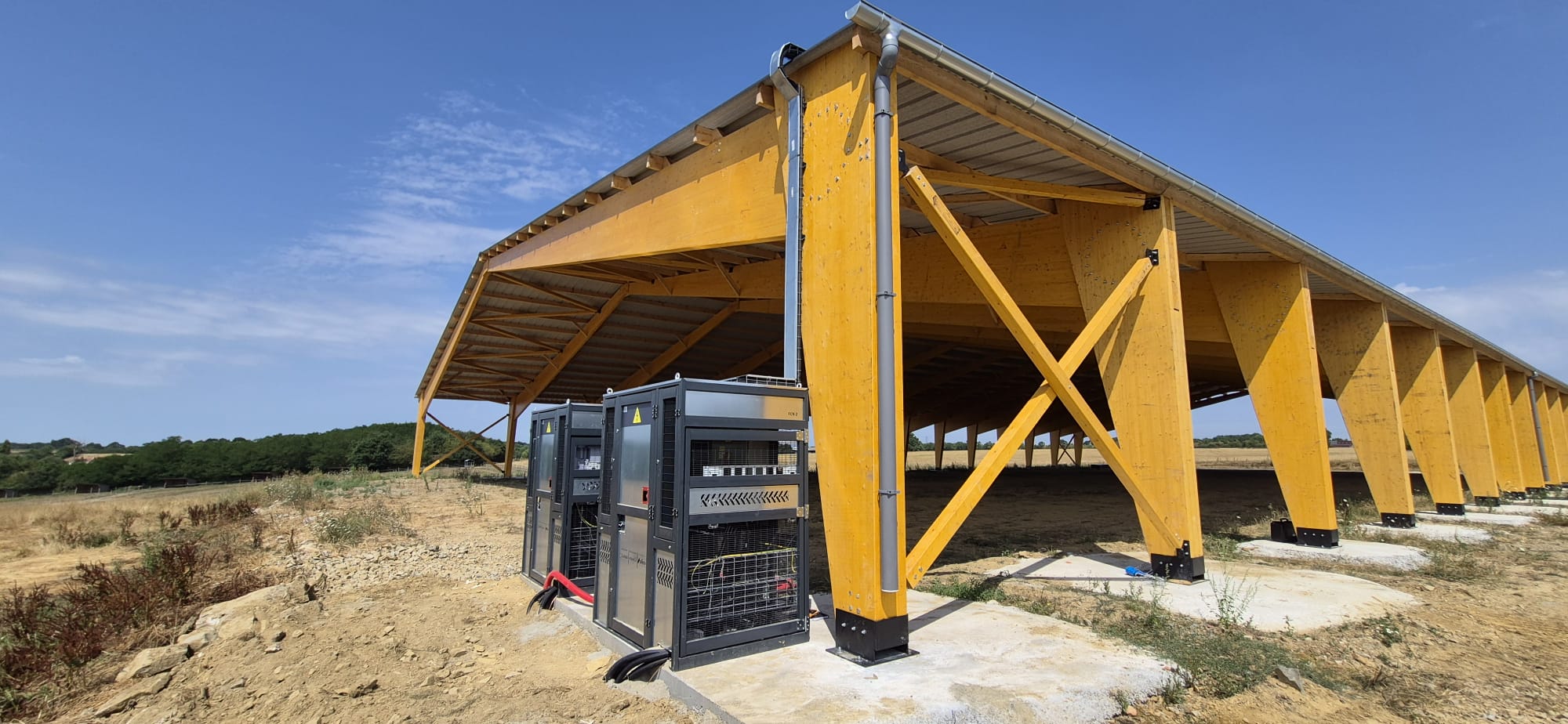
The first, in the north and west, covers fifteen farm sites across ten départements, from the Manche coast to the Côte-d'Or. Most involve erecting a new agricultural barn whose roof carries the array — the farmer gains covered storage for machinery, fodder or horses, the developer gains a generation asset. Twenty-five delivery points in all.
The second sits four hundred kilometres south, on a single estate near Alès in the Gard. Five existing barn roofs, one grid connection, 500 kWp. No new building — the work happens on roofs that have been in service for decades. It is in final commissioning, due on the grid in Q4 2026.
Together: 7 MWp, twenty-six plants, sixteen sites, an estimated 7,450 MWh a year.
Challenge
The two programmes fail in opposite ways.
In the north, the risk is dispersion. Sixteen construction sites spread over six hundred kilometres, each with its own landowner, soil study, Enedis connection file and building permit. None is large on its own; together they are unforgiving. A delayed lease signature or a foundation redesign on one site cannot be allowed to stall steel deliveries on four others. Every site is a working farm — cattle in the next barn, harvest traffic on the access track — so the works fit around the farming calendar, not the other way round. And behind all of it, the S21 clock: the grid connection must be live within twenty-four months of the tariff being granted.
In the south, the risk is the roofs themselves. Asbestos sheeting had to be stripped and disposed of under controlled conditions before anything else could start. The frames underneath were never designed to carry an array, and were reinforced structurally before a single module was fixed. On this project, stripping and strengthening the roofs cost more than the photovoltaic supply itself. The plant was also sized at 499.95 kWp — fifty watts under the 500 kWp ceiling of the S21 open window, above which the project would have had to go through a CRE tender with entirely different lead times.
Solution
SunBuild standardised what could be standardised and managed the rest site by site.
The same module, the same inverter platform, the same mounting system across both portfolios — which turned procurement into a single order book and made every technical review reusable. In the north, structures were split between two framing contractors, glulam timber and steel, so that neither became a bottleneck. In the south, asbestos removal and roof reinforcement ran ahead of the electrical works as a separate, sequenced trade.
Engineering was verified rather than assumed. The southern site's yield was modelled in PVsyst at a P50 of 648.9 MWh a year, 1,298 kWh/kWp, for a performance ratio of 82.4 % — and the same review flagged that the AC side was oversized for a mostly east-west layout, along with inverter cable runs averaging two hundred metres to the delivery point. Both were raised as design changes rather than discovered on site.
Installation, electrical works and technical inspection ran through qualified partners under SunBuild coordination, with a consolidated progress report issued to the client at every milestone: permits, foundations, framing, roofing, module and inverter installation, Consuel, Enedis commissioning. Three plants in the northern portfolio are already exporting to the grid. The southern site is in final commissioning, due on the grid in Q4 2026; the remaining plants follow the same track.
Annual output combines a PVsyst P50 simulation for the southern site with regional yield estimates for the northern portfolio. Figures for plants not yet commissioned are projections.



Application
Agricultural rooftop
Date
2025-2026
Location
Six regions, France
Size
7 MWp
7 MWp across sixteen French farm sites: new barns from Normandy and the Loire to the Gard.
Overview
Two portfolios of solar projects on French farmland came to SunBuild with a single requirement: treat them as programmes, not as a queue of small jobs.
The first, in the north and west, covers fifteen farm sites across ten départements, from the Manche coast to the Côte-d'Or. Most involve erecting a new agricultural barn whose roof carries the array — the farmer gains covered storage for machinery, fodder or horses, the developer gains a generation asset. Twenty-five delivery points in all.
The second sits four hundred kilometres south, on a single estate near Alès in the Gard. Five existing barn roofs, one grid connection, 500 kWp. No new building — the work happens on roofs that have been in service for decades. It is in final commissioning, due on the grid in Q4 2026.
Together: 7 MWp, twenty-six plants, sixteen sites, an estimated 7,450 MWh a year.
Challenge
The two programmes fail in opposite ways.
In the north, the risk is dispersion. Sixteen construction sites spread over six hundred kilometres, each with its own landowner, soil study, Enedis connection file and building permit. None is large on its own; together they are unforgiving. A delayed lease signature or a foundation redesign on one site cannot be allowed to stall steel deliveries on four others. Every site is a working farm — cattle in the next barn, harvest traffic on the access track — so the works fit around the farming calendar, not the other way round. And behind all of it, the S21 clock: the grid connection must be live within twenty-four months of the tariff being granted.
In the south, the risk is the roofs themselves. Asbestos sheeting had to be stripped and disposed of under controlled conditions before anything else could start. The frames underneath were never designed to carry an array, and were reinforced structurally before a single module was fixed. On this project, stripping and strengthening the roofs cost more than the photovoltaic supply itself. The plant was also sized at 499.95 kWp — fifty watts under the 500 kWp ceiling of the S21 open window, above which the project would have had to go through a CRE tender with entirely different lead times.
Solution
SunBuild standardised what could be standardised and managed the rest site by site.
The same module, the same inverter platform, the same mounting system across both portfolios — which turned procurement into a single order book and made every technical review reusable. In the north, structures were split between two framing contractors, glulam timber and steel, so that neither became a bottleneck. In the south, asbestos removal and roof reinforcement ran ahead of the electrical works as a separate, sequenced trade.
Engineering was verified rather than assumed. The southern site's yield was modelled in PVsyst at a P50 of 648.9 MWh a year, 1,298 kWh/kWp, for a performance ratio of 82.4 % — and the same review flagged that the AC side was oversized for a mostly east-west layout, along with inverter cable runs averaging two hundred metres to the delivery point. Both were raised as design changes rather than discovered on site.
Installation, electrical works and technical inspection ran through qualified partners under SunBuild coordination, with a consolidated progress report issued to the client at every milestone: permits, foundations, framing, roofing, module and inverter installation, Consuel, Enedis commissioning. Three plants in the northern portfolio are already exporting to the grid. The southern site is in final commissioning, due on the grid in Q4 2026; the remaining plants follow the same track.
Annual output combines a PVsyst P50 simulation for the southern site with regional yield estimates for the northern portfolio. Figures for plants not yet commissioned are projections.
Infos
Cours Saint-Michel 30B, 1040 Etterbeek
+32 474 792 892
Copy mail
copy mail
Vacancies
Follow us

Powering a brighter future.
Infos
Cours Saint-Michel 30B,
1040 Etterbeek
+32 474 792 892
Copy mail
copy mail
Vacancies
Follow us
Powering a brighter future.
© Crafted by
SunBuild
Infos
Cours Saint-Michel 30B, 1040 Etterbeek
+32 474 792 892
Follow us
Powering a brighter future.
Infos
Cours Saint-Michel 30B, 1040 Etterbeek
+32 474 792 892